Letters and photographs revealing Rowan's parentage
The RadleysLetters and photographs revealing Rowan's parentage are the hidden record Rowan discovers in Will Radley’s van: a sequence of childhood images and a letter from Helen Radley dated 17 September 1998. The photographs make Rowan’s own past an object of recognition, while Helen’s account explains why she separated from Will and tried to keep him away from their son. Their discovery turns a search for vampire blood into a confrontation with the concealed history of Rowan’s family.
Discovery in the van
On a Monday evening, Rowan goes to Will’s van looking for a fresh bottle of vampire blood. Will is absent, so Rowan tries the door and searches inside. He finds an empty bottle and leather-bound journals beneath the mattress, neither of which can meet his immediate need. A rolled sleeping bag contains an unopened bottle, but lifting it also shifts the lid of a shoebox. Beneath the lid is the family’s phone number, a detail that connects the concealed box to the Radleys rather than to an unrelated cache.
Inside, a bundle of photographs is held together with an elastic band. The first shows a baby boy sleeping on a sheepskin rug. Rowan recognizes the child as himself. The discovery is therefore not simply a collection of old pictures: it abruptly makes an unfamiliar archive personal. Rowan had gone into the van seeking something he could use; instead, the box presents evidence of a childhood whose record he did not know Will possessed.
The photographs of Rowan’s childhood
The images trace Rowan from infancy through his first years, moving from babyhood to toddlerhood and school age. They stop when he is about five or six. Their sequence gives the box the shape of a partial family history: it preserves the years when Rowan was growing up, but ends before his childhood is complete. The stopping point makes the photographs feel selected rather than comprehensive, a record bounded by an adult decision.
One birthday photograph supplies a particularly specific link between the pictured child and Rowan’s remembered life. His face is covered in a rash that Helen had told him was German measles. The image does not merely identify him as the baby in the first photograph; it brings a past explanation into question by placing a familiar childhood episode among Will’s private papers. Rowan’s response is to seek an explanation in the letters bundled with the pictures. The photographs establish recognition first, then leave the reason for their presence unresolved until the written record is opened.
Helen’s final letter
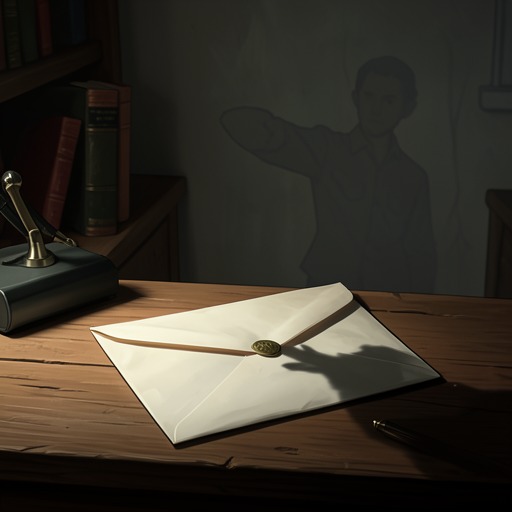
The letter at the top of the pile is dated 17 September 1998 and addressed to Will. Helen describes it as her final letter to him. She connects the decision to end their correspondence with Rowan starting school, arguing that it is time for them to continue their lives for the children’s sake. In recounting ordinary care—getting the children dressed, changing Clara’s nappy, tending to a sore gum, and giving Rowan medicine—she describes moments when family routine allows her to feel almost normal and to forget Will.
Helen also gives her interpretation of their separation. She says that Will did not want a faithful partnership if it meant giving up the excitement of new blood, and recalls that he was horrified when she told him she was pregnant. She fears that Rowan is increasingly resembling Will, even as she distinguishes their temperaments and describes her responsibility as his mother to guide him differently. The letter thus joins the photographs’ visual evidence to Helen’s account of the relationship: Rowan’s likeness is not an accidental resemblance in her eyes, but a source of anxiety tied to Will and to the life she is trying to leave behind.
Her farewell sets a boundary around the photographs and the relationship. Helen asks Will not to try to see either her or Rowan, invoking a promise they had made and saying it must be kept for everyone’s sake. She presents the decision as painful but necessary, and ends by acknowledging that she will miss him. The box therefore holds both an intimate record of Rowan’s early life and the written terms of his separation from Will: the photographs preserve contact at a distance, while the letter insists that distance must continue.
What the archive changes
Rowan lets the letter fall, takes the unopened bottle of blood from the sleeping bag, and leaves the van. The juxtaposition matters: he does not remain to sort or preserve the papers, and his practical need continues even as the discovery overwhelms him. He wants to erase what he has just learned, but the concealed record has already altered his understanding of his family. The box makes the past materially present at the moment he was focused on getting what he needed for the evening.
As Rowan walks up Orchard Lane, Will approaches him. The encounter follows directly after the discovery: Rowan has just seen himself in the photographs and read Helen’s account of Will’s reaction to her pregnancy and her demand that he stay away. Will’s casual greeting meets a son who now carries evidence of a history Will had hidden in his van. The papers do not resolve every question in the scene, but they change the terms of the meeting. The box’s significance lies in that reversal: what Rowan sought as a source of blood becomes the route to the truth of his parentage and to a past his mother had tried to close.